Single or multi-ply twisted yarns (BCF or spun) are commonly used in carpet production through weaving or tufting techniques. Using these types of yarns, carpets with diverse patterns and varied technical properties can be manufactured, allowing:
• Increasing yarn thickness.
• Combining multiple yarns of different natures.
• Placing yarns of different colors or with varying dyeability side by side.
Typically, a specialized finishing process called Heat-Setting is applied to these yarns. To ensure that the properties imparted by twisting remain permanent, the yarn twist is set at high temperatures, either in an autoclave or through a continuous heat-setting process. These operations must be carried out with high precision. Using heat-set yarn in carpet weaving guarantees that the carpet's plush appearance is maintained.
BCF yarn intended for carpet applications undergoes a three-step process:
1. BCF yarn extrusion
2. Twisting or cabling of the yarn
3. Heat-setting of the yarn
The heat-setting process contributes to the long-term durability of the carpet’s appearance. It enhances the carpet's:
• Resistance to abrasion and foot traffic (resilience)
• Dye affinity
• Dimensional stability
• Design integrity and pattern clarity
Proper heat-setting produces a precise pin-point effect, which refers to the extremely fine and sharp appearance of the yarn tips on the carpet surface. This results in:
• Very clear and sharp visibility of patterns and designs.
• A uniform, granular appearance.
• More prominent texture details.
• A softer hand feel.
• Prevention of pile spreading or flattening over time.
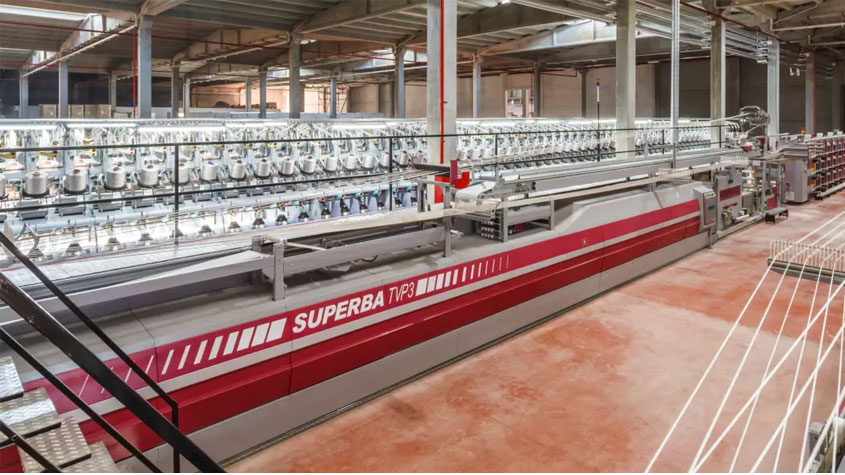
One of the leading companies in carpet yarn heat-setting machinery is SUPERBA. SUPERBA's continuous carpet yarn heat-setting equipment can process various yarns used in carpet and rug production, including:
• Synthetic fibers: polypropylene, polyamide, polyester, acrylic, etc.
• Natural fibers: wool
• Blended fibers
The heat-setting process can be carried out using saturated steam under pressure or overheated steam
Overheated steam refers to steam whose temperature is higher than the saturation temperature at a given pressure, meaning:
• It is no longer in equilibrium with liquid water.
• It is completely dry, with no water droplets present.
• It is generated by further heating after all water has vaporized.
Differences between overheated steam and saturated steam:
• Saturated steam: at the condensation threshold and may contain moisture.
• Overheated steam: drier, hotter, and with different heat transfer characteristics.
SUPERBA offers both heat-setting methods through two machines: TVP/3 and DHS3.
1. TVP/3 Machine

In this machine, the yarn is heat-set using saturated steam under pressure at a lower temperature compared to the overheated steam process. This is due to the higher heat transfer capacity of the saturated steam method. (In the TVP/3 process, the heat exchange capacity is 1160 k·m²/W°, whereas in the overheated steam process it is only 392 k·m²/W°).
Using this method for yarn heat-setting ensures that the carpet pile tips remain individually distinct, do not stick together, and also enhances their resilience after foot traffic.
SUPERBA's TVP/3 system delivers the highest performance level among its class, including:
• Maximum productivity
• Full quality control
• Low operational costs
• Minimal resource consumption
• Reduced waste
• Ease of operation
This heat-setting line can be configured and customized according to the specific requirements and requests of the customer.
Advantages:
• Low energy consumption
• No emission of smoke or polluting vapors
• High clarity of pile tips / precise pin-point effect
• Long-lasting heat-setting effect (resilience and long-term stability)
• Production of streak-free carpets, meaning the pile appears uniform and even in terms of color and nap, without longitudinal streaks or patches when viewed under changing light angles
• Increased dye uptake (especially for polyamide yarns)
• No yellowing or oxidation of fibers
2. DHS3 Machine

In this machine, the yarn is heat-set using overheated steam. The standard configuration includes a DAV3 unit, which heat-sets the yarn for straight-set yarn. If the customer requests textured yarn, the machine can be equipped with MF400/MF4 units.
In this system, texturizing and heat-setting are performed in a single step. After the process, the yarn becomes High bulk, and its stain resistance is improved. The machine is suitable for heat-setting polyamide, polypropylene (P.P.), and PET yarns with a yarn count ranging from 900 to 5000 dTex. It can process up to 96 yarn ends simultaneously.
The yarn passes through the machine in the bundle turnaround with 3 layers, ensuring uniform heat-setting of all yarn strands (this method is currently patent-pending). This results in a more consistent carpet appearance. The machine has a heat-setting capacity of 580 kg of yarn per hour.
SUPERBA has incorporated energy efficiency, environmental sustainability, and eco-friendly solutions into the design of this heat-setting line. Moreover, the machines are engineered for long operational life, ensuring reliable and durable performance in carpet production.